Life Is a Breath — Dolce Vita in Munich
A feuilleton essay on Oscar Niemeyer, Fellini's sweet life, and a night in Munich's Glockenbachviertel that felt like a movie.
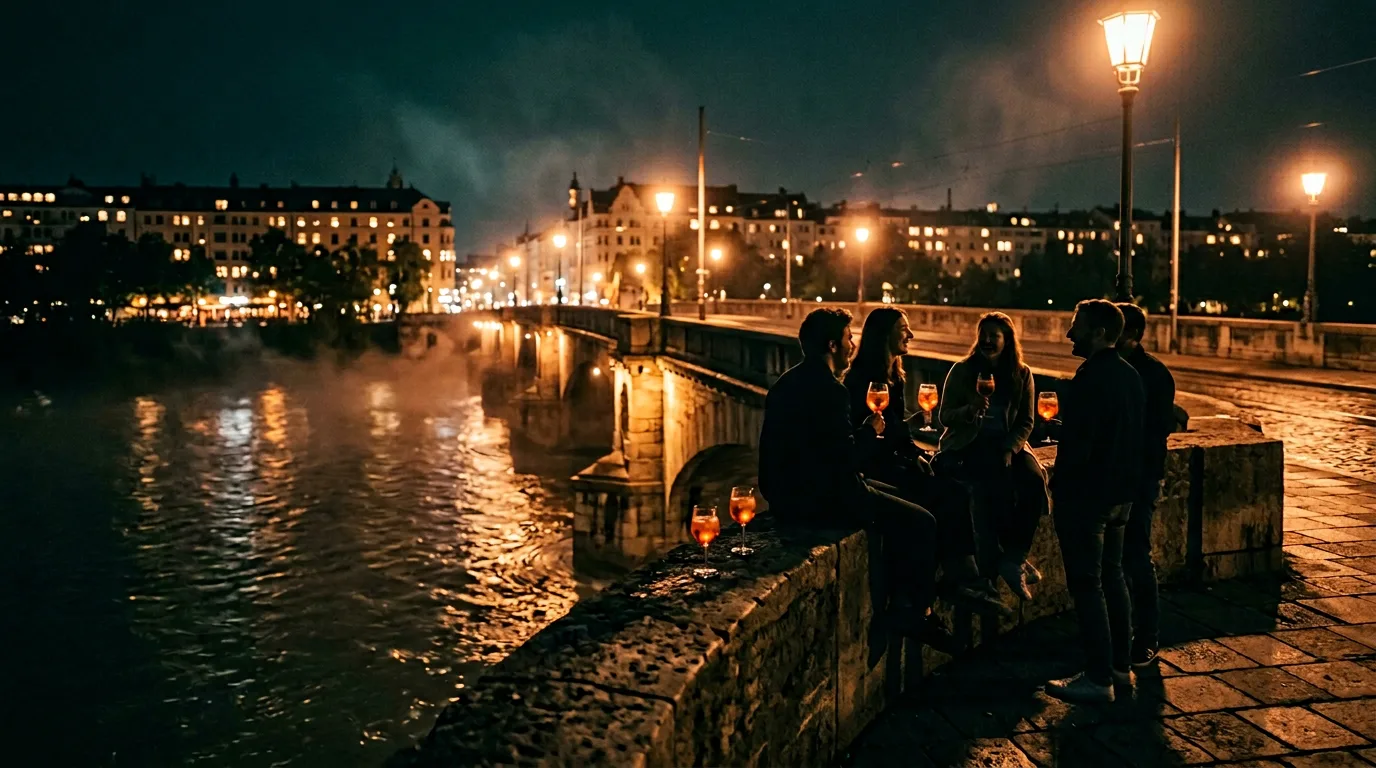
It’s just past two in the morning, the Isar glitters beneath the Reichenbach Bridge, and someone says a sentence that will not leave this evening: “Sometimes life is like a movie.” We’re standing outside a club in the Glockenbachviertel, where the bouncer has just told a guy from Hamburg — for the tenth time — to please keep it down out here. Not rudely, more like a neighbor who knows they’ll see each other again tomorrow. In Ischgl, they’d have snatched the beer right out of your hand. Here, someone tells you with Munich composure that there happen to be neighbors. This friendliness is neither coincidence nor folklore — it’s a stance. In a country where the AfD leads national polls, where the tone grows harsher and the lines harder, Munich remains a city of dialogue. People talk with each other, not about each other. Even with the guy from Hamburg who’s too loud. Even the tenth time around. The rainbow pedestrian signals glow green. From a bar drifts something that sounds like Italo-disco. A bicycle passes, no lights, naturally. And this sentence hangs in the air like the scent of Aperol and warm asphalt: Sometimes life is like a movie.
The sentence has no author. It sits on no quotation website with a proper source, no philosopher coined it, no poet claimed it. It belongs to the collective consciousness of the night, to those moments when every thread — music, people, light, temperature — converges until experience reaches an intensity you otherwise know only from cinema. You already know, while living it, that you will remember it. Nostalgia in the moment. This is the feeling Munich gives away on its best evenings — free, unconditional, fleeting.
Thousands of kilometers south, in a studio on the Copacabana, an old man with white hair and alert eyes once said something similar, only more fundamental. Oscar Niemeyer, the Brazilian architect who drew Brasília out of nothing into the red dust of the Cerrado, who rebelled with his curves against the right angles of modernism and married again at 98 — this Niemeyer said in a BBC interview: “A vida é um sopro.” Life is a breath. And then, as if to immediately relieve the existentialist weight of that statement: “I attach no importance whatsoever to money. Not even to life itself. Life is a breath, a minute. You are born, you die. The human being is a completely abandoned creature.”
You have to hear this quote in context to understand why it isn’t pessimistic. Niemeyer, the atheistic Catholic, the communist individualist, as German film critics called him, meant it as liberation. Precisely because life is fleeting, you must make it beautiful. Precisely because humans are abandoned, they need solidarity, beauty, the curve instead of the right angle. “My architecture was made from courage and idealism,” he said. And about the Bauhaus, that sacred cow of German design history: “A paradise of mediocrity.” Niemeyer didn’t build buildings — he built invitations to live. The MAC Niterói, his flying saucer above the Guanabara Bay, floats on a single slender pillar, sixteen meters above the rocks, and looks like something that could take off at any moment. Like the moment itself. Like life — a breath.
Germans know this phrase, even if they may not know Niemeyer. The ZDF, Germany’s public broadcaster, used it as the title of its 2014 World Cup highlight film, when Germany won the title in Brazil — of all places, in Niemeyer’s country, in Niemeyer’s stadiums. Bastian Schweinsteiger, his face bloody, his body spent, sacrificed down to the last drop, said after the final: The Glockenbachviertel should celebrate. He meant Munich. He meant this neighborhood. He meant this feeling you can’t plan but that’s there when everything comes together — the city, the night, the people, the moment. At Campo Bahia, the German team’s base camp on the Brazilian coast, they had played Schafkopf between matches — a Bavarian card game as old as the hills. You can’t win a World Cup more Bavarian than that.
Fellini called his Dolce Vita “simply the deep, undeniable sweetness of life” — in spite of everything. Munich in the spring of 2026 lives this sweetness, and lives it with an intensity that borders on fiction. On March 22nd, the city elected Dominik Krause as mayor — the first Green mayor of a German city with over a million inhabitants, with 56.3 percent, in eighteen of twenty-five districts. The SPD, which had governed Munich almost uninterruptedly since 1945, lost its last great bastion in Bavaria. The Greens are the strongest force in the city council at 26.5 percent. Svenja Jarchow commented: “Munich is making history.” And the ousted Dieter Reiter, with a candor rare in German politics: “I blew it. It’s my fault.”
What does this mean for a city that has understood itself for centuries as the northernmost city of Italy? Where thirty thousand people hold Italian passports, nearly six hundred Italian restaurants operate — supposedly more than in Florence and Siena combined — where Electress Henriette Adelaide of Savoy commissioned the Theatine Church in 1662, the first church in the style of Italian late Baroque north of the Alps, and King Ludwig I had entire streets designed after Florentine models? The Feldherrnhalle — a copy of the Loggia dei Lanzi. The Königsbau of the Residenz — modeled on the Palazzo Pitti. At the Old Town Hall stands a Juliet statue, a gift from twin city Verona. Munich didn’t just cultivate the German longing for Italy — it carved it in stone. From Goethe’s “Know’st thou the land where the lemon-trees bloom” to the Aperol Spritz in the beer garden at Gärtnerplatz — the longing is the same, only the medium has changed.
A Green mayor in the capital of the CSU’s Free State. This is not a political detail — it’s a cultural statement. While the AfD posts record numbers nationwide, in Munich it is irrelevant — single digits, no fertile ground, no resonance. Not because Munich has no problems. But because this city makes a counter-offer: quality of life instead of fear, openness instead of isolation, dolce vita instead of dull rage. Munich has moved further from Bavaria than ever. And simultaneously closer to itself. Because this city has always been different: Germany’s longest-running red-green coalition from 1990 to 2014, 1,200 kilometers of cycling routes, the renaturalized Isar — eight kilometers of concrete canal transformed into natural gravel banks, an internationally acclaimed showcase project that draws inquiries from around the world. The Water Authority says: “Munich is envied for its livable river in the heart of a major city.” Niemeyer would have loved the Isar renaturalization. Curves instead of right angles. Organic instead of functional. Beauty instead of efficiency.
But Fellini also showed in La Dolce Vita the emptiness behind the glamour — Marcello, who in the end can no longer hear innocence calling. This warning applies to Munich too. Germany’s most livable city — number one at Monocle, number one in the WirtschaftsWoche ranking since 2013 — also has the most expensive housing market. In the Glockenbachviertel, on this single square kilometer where nineteen thousand eight hundred people live and sixty-five percent of them alone, the average cold rent is 24.28 euros per square meter. Purchase prices: 12,100 euros. The Harry Klein closed in 2023 — demolished for a hotel. The legendary Registratur closed in 2017 after noise complaints from neighbors. The Blitz Club on the Museum Island, named by Mixmag in 2017 as one of the ten best new clubs on the planet, closes in August 2026. The clubs are dying, and with them the places where sentences like “Sometimes life is like a movie” can come into being.
And yet. The Rote Sonne on Maximiliansplatz — co-founded by Martin Gretschmann of The Notwist, named after a 1969 film — has been running community nights since 2025 on a pay-what-you-can basis. Its trademark: a sprung oak dance floor that transmits the vibrations of the bass directly into your body. The Pimpernel on Müllerstraße, an institution since the 1930s — first a brothel, then a gay bar, now a techno club, Freddie Mercury was a regular — is still there. At Karl-Heinrich-Ulrichs-Platz, a pink maypole is raised every May 1st. At the Sub, during the Hans-Sachs Street Festival, red roses rain down on the crowd at 8 PM to Hildegard Knef’s “Für mich soll’s rote Rosen regnen.” These are not tourist attractions. They are acts of the art of living against the logic of the market.
And then there’s this summer, which could bring it all together. Munich showed in 2024 what’s possible — Taylor Swift and Coldplay at the Olympic Stadium, the European Championship with its fan zones, a city in collective rapture. Now, 2026: the FIFA World Cup, and it’s not impossible that FC Bayern will be in the Champions League final — once again a year after a final at the Allianz Arena, as in 2012 and 2013. The city could explode with joie de vivre. Dolce Vita, Bavarian style, on the grandest scale.
2012 and 2013 — Munich knows this pattern. The city knows what losing feels like and what getting back up means. In May 2012, during the Finale dahoam, an entire city had its plug pulled. Drogba equalized, Schweinsteiger missed his penalty, and Munich flatlined. A breath that stopped. And in that same year, on December 5th, Oscar Niemeyer died in Rio, ten days before his 105th birthday. The man who had said life is a breath became a breath himself. But Munich got back up — one year later, at Wembley in another great city, Robben in the 89th minute, the title. Because that’s what this city does: fall down and keep building.
Niemeyer would have understood. On his 102nd birthday, he had said: “Turning 102 is rubbish, and there’s nothing to celebrate.” And then: “The date is not important. Age is not important. Time is not important. Life is very fleeting. What matters is to be gentle and optimistic.” He built curves because life doesn’t follow straight lines. He built buildings that touch the ground softly, that float and surprise — because life is a breath and you must hold up something beautiful against that breath. Eduardo Galeano said of his architecture in Rio: It was “created on the day God thought he was Oscar Niemeyer.”
Munich keeps building. Despite the rents, despite the dying clubs, despite Markus Söder. A city that elects a Green mayor, that liberates its river, that raises pink maypoles and where a sprung oak floor carries the bass into your bones — this city has understood what Niemeyer meant. Life is a breath. Sometimes it’s a movie.
Why does this live on a blog called Building Anyway? Tom Scott once stood on the chalk cliffs of Dover and talked about entropy — about how everything crumbles, the code, the cliffs, the things we build. And then he said: build anyway. The cliffs erode, and someone builds a sandcastle at their base. Munich is that sandcastle. More beautiful than it needs to be. More fleeting than you’d wish. And worth building for exactly that reason.
Life is a breath. Build anyway.