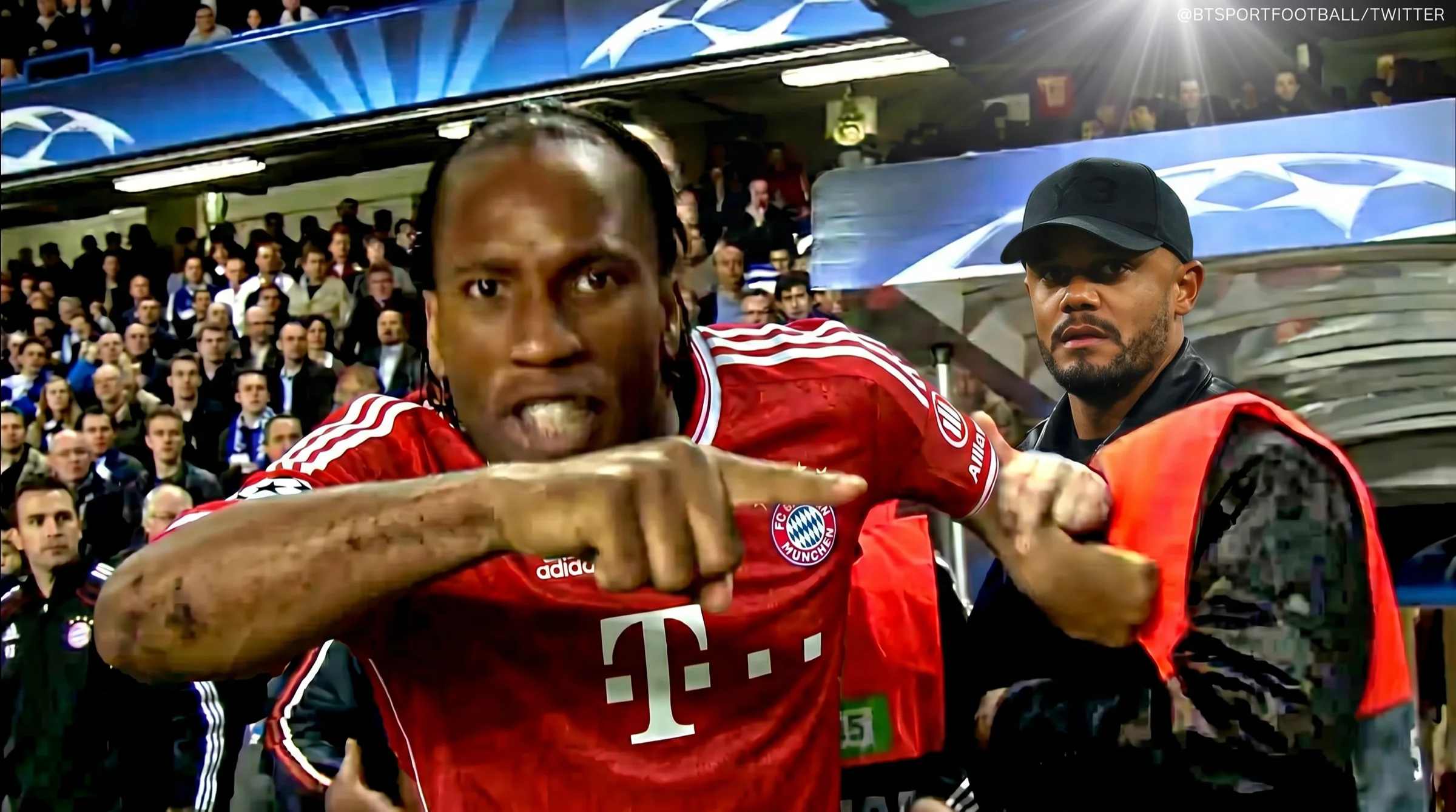
Bayern–Paris: From the Biggest Game to the Biggest Disgrace
Bayern lose 6–5 to PSG, Couch-Lock on a barstool in Munich's Lenbachviertel, the next morning a hollow march across a cloudy half-dead city — and at the end the question of what UEFA actually still is, when Polymarket treats the fans more honestly than UEFA does.
180 minutes against Paris Saint-Germain, 6–5 to PSG on aggregate, two penalty-box situations of identical geometry and opposite outcomes, a goal in the third minute and an equalizer in the ninety-fourth that didn’t quite suffice. And at the end: me, on a barstool in the Lenbachviertel, not sad, not angry, not resigned. Just there.
That’s the actually remarkable part. Not the game, not the referee, not the aggregate goal in Paris. But the state I was sitting in afterwards — and the state I’m still sitting in now, one May morning and one office chair later. Couch-Lock without the sleep, body heavy, eyes open, head empty. Friedrich Merz would have been proud. Model citizen of emotional standstill. Existing and getting on with my work. Nothing more. Nothing less.
The Two Hands in the Box
Two handball situations held this two-leg semifinal together like a clamp. First leg at the Parc des Princes, April 28, stoppage time of the first half: a Dembélé cross strikes Alphonso Davies on the hip, then on his slightly extended arm. Swiss referee Sandro Schärer initially gives nothing, VAR sends him to the monitor, penalty, Dembélé converts to make it 3–2. Bayern lose this game 5–4 — the highest-scoring Champions League semifinal first leg in the competition’s history.
Second leg in Munich, May 6, 31st minute: Vitinha tries to clear inside his own box and blasts the ball from three meters into the outstretched arm of his teammate João Neves. Portuguese referee João Pinheiro waves it away. Italian VAR Marco Di Bello recommends no review. It’s by the book: under IFAB Law 12, a handball is not an offence when the ball is played at you by a teammate from short range. The rule applies — it’s there in the rulebook, and Pinheiro applied it correctly.
But. But.
A week earlier, in the same competition, in a directly connected two-leg tie, another referee distilled a penalty out of a softer movement. It’s not that the rules were broken — it’s that the rules permit two different answers, and which answer you get on a given evening depends on which half of the box you’re standing in and whose shirt you’re wearing. Vincent Kompany made the only sensible point afterwards: “I get the rules. But when you look at both phases with a bit of common sense, it’s just ridiculous.”
Bayern CEO Jan-Christian Dreesen was more concrete: “It’s astonishing, to say the least, that a referee with only 15 Champions League appearances is allowed to take charge of such a match.” Pinheiro, for the record, had exactly fifteen Champions League appearances on his ledger before this semifinal second leg. UEFA has issued no comment.
Walk of Shame, Without the Walk
There’s a particular way you lose a European semifinal as a Bayern fan. You know it. The body knows it. The barstool you’re sitting on knows it too. First the tension that starts two days early — you check the lineups, read the previews, talk to friends who haven’t talked about football since the last semifinal exit two years ago. Then the game itself, in which you forget for half an hour that you actually have expectations, because suddenly it’s close and good and maybe — and then the goal goes in and you remember. Ah yes. So this is what it feels like. Again.
What used to be anger is now numbness. What used to be worth a slap on the table is now a quiet exhale. You don’t move, you just keep sitting and watch as the highlights play back ten times in slow motion. UEFA’s broadcasters know what they’re doing. These endless replays are no accident — they sell the hope of correction as content. You stare at the hand rising in the box, three, four, five seconds in slow motion, and you wait for someone to do something. Nobody does. The game has long since moved on. A collective murmur passes through two million living rooms across southern Germany, and nobody on the pitch hears it.
That’s the most honest description of what this club and this competition do to their fans: they’ve trained the feeling out of us.
Drogba, Three Times
There’s a line in this story that runs through Didier Drogba.
May 6, 2009, Stamford Bridge. Chelsea vs. Barcelona, semifinal second leg. Three or four ungiven penalties, depending who’s counting. Iniesta equalizes in the 93rd minute, Chelsea go out on away goals, and Drogba runs onto the pitch, into the camera, across the worldwide broadcast — “It’s a fucking disgrace!” Tom Henning Øvrebø, the Norwegian referee, needed a police escort out of the stadium. To this day, that game stands as the greatest refereeing scandal in Champions League history.
May 19, 2012, Allianz Arena. Finale dahoam. Bayern lead through Müller’s 83rd-minute header, everything is programmed for a home win, and then — 88th minute, Mata corner — Drogba heads in the equalizer. Extra time, penalties. Drogba converts the winning kick. What the cameras show next is famous: Drogba walking over to Bastian Schweinsteiger, putting his arm around him, talking to him for several minutes. Three years after his own disgrace, he becomes the comforter of those he has just destroyed.
May 6, 2026, Allianz Arena. Exactly seventeen years after Stamford Bridge, same competition, same stage, same constellation: a club that got robbed against a club that benefited. Except this time Bayern is standing where Chelsea stood in 2009. Bayern–PSG 2026 has now joined the unofficial list of the biggest CL disgraces, sitting in second place right behind Chelsea–Barcelona 2009. And no one will console Bayern’s players today — not Pinheiro, not Khelaïfi, not the Swiss judiciary.
That’s the real punchline of 2026: there’s no Drogba. Drogba was pain with a face — a man who ran, screamed, scored, won, and then sat down to console. What Bayern were dealt that May night, nobody dealt. It just happened. And there’s no one left to scream at.
The Semifinal Is Bayern’s Final
The Finale dahoam — Bavarian for final at home — has long since become a genre. 2012, the original: Chelsea in the Allianz Arena, Drogba, Robben missing the penalty in extra time, Bayern losing their own home final on penalties. 2013, the reset: Wembley against Dortmund, the only big happy ending of the past decade. And since? One semifinal exit after another. Real Madrid 2014, the 0–4 at home, Pep Guardiola’s biggest coaching trauma. Barcelona 2015 with Messi’s brace. Atlético 2016 with the away-goals tragedy. Real Madrid 2018 — eight years ago now — with Marcelo’s handball in his own box that referee Çakir didn’t whistle. Marcelo himself put it on record: “It’s a handball, it hit me on the hand and I think it’s a penalty. If I say it didn’t hit me I’d be lying.” Real Madrid 2024 with Joselu’s two goals in the final minutes. PSG 2026.
Five consecutive two-leg semifinal exits. Eighth semifinal defeat in fourteen historical semifinal appearances. This is no longer a bad streak. This is a genre.
And the pattern isn’t subjective. When Bayern reach a European semifinal, on the other side stands almost always either a historical media giant (Real, Barça) or a petrodollar power (Atlético via Apollo Capital, PSG via the Qatari state). That’s no coincidence. That’s the topography of modern football. To reach the final rounds of the Champions League, you either have decades of historical accumulation behind you or a state that writes the balance sheets.
Bayern? Bayern is the richest club still trying to play football with its own money — €978.3 million in revenue for fiscal year 2024/25, EBITDA €187.8 million, operationally profitable every year since 2003 except the pandemic year. Seventy-five percent is owned by the registered members’ association; the rest is split between Adidas, Audi, and Allianz. From the wrong distance this looks heroic. Up close it looks naive.
Cash Has Four Letters
UEFA has four letters. FIFA has four letters. Cash has four letters. That isn’t coincidence but observation — the only three acronyms that actually mean something in international football all have the same letter count as the word that defines them at their core.
If you say PSG, you’re saying Qatar. Qatar Sports Investments, founded in 2005 by today’s Emir Tamim bin Hamad Al Thani, a subsidiary of the Qatar Investment Authority (estimated $557 billion in assets, August 2025), bought PSG in June 2011 for €69 million. Today, fourteen years later, QSI itself values the club at €4.25 billion — a twelve-fold increase. Mediapart documented in the 2018 Football Leaks files that between 2011 and 2018, Qatari sources injected roughly €1.8 billion into the club, primarily through a contract called the “Agreement for the Promotion of the Image of Qatar” between PSG and the Qatar Tourism Authority — €215 million per year on paper, valued at €123,000 and €2.78 million per year respectively in market terms by two UEFA-commissioned auditors (Repucom and Octagon). Factor of 1,750 to one. At the lower estimate.
In May 2014, UEFA and PSG settled: a €60 million fine, of which €40 million was conditionally refundable on compliance, the squad reduced to 21 players. The effective penalty was €20 million in withheld Champions League prize money. UEFA lifted the restrictions just 15 months later. The negotiator on UEFA’s side at these private meetings, documented in the Football Leaks: Gianni Infantino, then Secretary General, now FIFA President.
In 2017, after the €222 million Neymar transfer, UEFA opened a fresh FFP investigation against PSG. In June 2018 the Investigatory Chamber cleared the club. CFCB chairman Cunha Rodrigues, a former Portuguese ECJ judge, called the clearance “manifestly erroneous.” Greek law professor Petros Mavroidis resigned from the chamber in protest. CAS upheld the clearance in March 2019 — on a procedural technicality. In September 2022 came the next penalty: €10 million unconditional, up to €65 million in total. PSG’s wage bill in the 2021/22 season was €729 million — a wage-to-revenue ratio of 108 percent.
Manchester City, the other corner of the same story, with Sheikh Mansour from the United Arab Emirates at the top: in February 2020 UEFA imposed a two-year Champions League ban and a €30 million fine. In July 2020 CAS overturned the ban — not because City was innocent, but because the most serious charges were time-barred. CAS still imposed a €10 million fine for “obstructive cooperation” with the investigation. With enough lawyers, Financial Fair Play is a recommendation, not a law.
The Many Hats of Nasser Al-Khelaïfi
If you say PSG, you inevitably also say Nasser Al-Khelaïfi. The former tennis pro from Doha simultaneously wears the following hats:
- President of Paris Saint-Germain (since October 2011)
- Chairman of Qatar Sports Investments
- Chairman of beIN Media Group — the world’s largest non-European buyer of UEFA broadcast rights
- Chairman of European Football Clubs (formerly the European Club Association, since April 2021)
- Member of the UEFA Executive Committee (since 2019, re-elected through 2028)
- Chairman of the UEFA Club Competitions Committee
- Member of the FIFA Council (since October 2025)
- Minister of State of Qatar (since November 2013)
- Board member of the Qatar Investment Authority
As La Liga president Javier Tebas put it in 2022: “He wears a lot of hats, there’s too many conflicts of interest and this cannot be.” UEFA has said nothing in response. It re-elected him to its Executive Committee in 2024.
In Al-Khelaïfi’s person concentrates everything Swiss prosecutors have been failing to pin down for ten years. In 2020, 2022 and 2024 he was acquitted at three levels — most recently by the Swiss Federal Supreme Court in May 2024 — of having allowed former FIFA Secretary General Jérôme Valcke free use of a Sardinian villa in 2013, in exchange for World Cup MENA broadcast rights. Valcke was convicted of accepting bribes. Al-Khelaïfi was acquitted. Both are legally correct. Both are simultaneously remarkable. In February 2025 he was indicted in Paris in the Lagardère affair — the charge: vote-buying at a QIA shareholders’ meeting. Proceedings ongoing.
In November 2024, Bayern fans displayed a banner in the Allianz Arena: how could a single person simultaneously be club owner, UEFA Executive Committee member, ECA chair, and broadcast rights holder? Bayern issued a formal apology.
Solidarity, in Numbers
And then there’s the distribution itself. The 2024/25 Champions League season generated €4.4 billion in gross revenue. Of that, €2.467 billion went to the 36 clubs in the league phase. PSG, the winners, took €144.4 million from that pot — a club record. Slovan Bratislava, the Slovak champions who lost all eight league-phase games, took €21.87 million. Factor of 6.6.
To all non-participating clubs across 55 federations combined, €308 million flowed in solidarity payments — seven percent of gross revenue. UEFA sells this as reform: it used to be four percent. But the pot from which PSG drew its €144 million has simultaneously grown by a third. The absolute gap between elite and non-elite widened in 2024/25, it didn’t narrow.
At the launch of the new Champions League format in 2022, Nasser Al-Khelaïfi forecast that gross revenues would rise by 40 percent to £3.8 billion per season. That wasn’t a marketing claim. That was a forecast from the man who is simultaneously club owner, association functionary, and major buyer of broadcast rights for his own region. It has come true.
Polymarket Knows More Than UEFA
If you really want to understand modern football, you no longer look at the UEFA press release. You look at Polymarket and Kalshi — the prediction markets where real capital is placed on real probabilities. Bayern’s first leg in Paris alone moved $10.82 million in trading volume on Polymarket; the second leg in Munich, $9.5 million. At kickoff yesterday evening Kalshi had Bayern at 61 cents, Draw at 18, PSG at 24. Pinnacle, the world’s sharpest bookmaker, had practically identical odds. After Dembélé’s third-minute goal, Polymarket repriced “PSG to reach the final” from 73 percent pre-match to 95 percent within minutes.
Here’s the unexpected finding: these markets were clean. No unusual movements, no late spikes, no suspicious wallets. Sportradar’s Universal Fraud Detection System flagged 1,116 of more than one million matches monitored across all of 2025 as suspicious — none were Champions League semifinals. The International Betting Integrity Association issued 70 alerts in the first quarter of 2026, all from lower-tier leagues in Burundi, Ghana, Nigeria, or Albania’s Superliga. Not from the Parc des Princes.
That’s the uncomfortable truth I probably don’t want to hear in my Couch-Lock state: the game wasn’t bought. It was simply a money-distribution machine doing what it does — with Vitinha’s clean shot at his teammate’s arm, with Davies’s shrug a week earlier, with a referee who is overseen, in the final instance, not by UEFA but by the Swiss Federal Supreme Court, because EU civil courts have no jurisdiction. What the prediction markets can do — pricing in real time, anonymous orderbook access, reaction to information without delay — UEFA cannot. What it offers us is slow-motion loops with collective murmuring and a referee with fifteen games.
In March 2026, Joshua Mitts and Moran Ofir documented in a paper on the Harvard Law School Forum $143 million in anomalous profits on Polymarket — across all markets, not just sports. That exceeds chance expectation by more than sixty standard deviations. So yes, prediction markets do contain insiders, that’s been studied. But finding them is possible because the orderbook is public. It’s on the blockchain. You can trace wallet addresses to real people. Compare that to UEFA’s Adjudicatory Chamber: a black box with three primary occupants — one of whom regularly also sits on the ECA, whose chairman owns the club whose FFP violation he is not reviewing. That isn’t complication. That’s architecture.
I was awake at seven. Six hours of sleep, no dreams, which was probably appropriate. The morning over Munich was hazy and gray, May felt like early March, and the city had that specific kind of half-dead it always has after lost Champions League semifinals. I’ve seen it a few times. It’s seen me a few times.
An hour later I walked across the Donnersberger Brücke. Below me the train tracks, above me the Mittlerer Ring, to my left the BMW towers in the haze. Commuters with coffee-to-go streamed toward the S-Bahn entrance. Nobody looked anyone in the eye — that’s apparently not the convention up here. I didn’t either. Walk of Shame in the commuter stream. I’m not the only person in this city who doesn’t know what to do this morning with the information that a handball in the box wasn’t a handball.
In three weeks PSG plays Arsenal in the final in Budapest. Qatar Airways is a Champions League sponsor (six years, just under €500 million), PSG’s shirt sponsor (€70 million per year), and was simultaneously the loser Inter Milan’s training-kit sponsor in the 2025 final — what the airline itself promoted as a “sponsorship treble.” If that were a bet, Polymarket would accept it.
Next year is another semifinal. Maybe Bayern will be there. Maybe on the other side will be another club whose owner you can’t pronounce without scanning a passport. And maybe I’ll be sitting again at some bar counter in this city — Lenbach, Glockenbach, Schwabing — and watching.
Not because I still believe it’s a fair competition. But because what you have as a fan with a club isn’t easily unlearned, just because the club plays in a league that no longer belongs to it.
In sixteen days Bayern plays the German Cup final in Berlin against Stuttgart. Different competition. Different referees. An architecture in which nobody on the other side simultaneously sits on the UEFA Executive Committee, owns parallel broadcast rights, or pays the club with a Doha passport. That won’t be a perfect world either.
But it’s small enough to still feel honest. And on a May morning at the Donnersberger Brücke, with a half-dead city and six hours of sleep in your legs, honest is the highest standard you can still ask of professional football.
Hero image: AI edit via Adobe Firefly based on a BT Sport still from the Chelsea–Barcelona semifinal second leg, 6 May 2009. Drogba wears a Chelsea jersey in the original; the man on the right is originally Chelsea assistant coach Steve Holland, here replaced with Vincent Kompany.